Legacy defines Roland Garros: its storied history, transformative innovations and status as a Grand Slam forge an aura unmatched on clay; the surface’s brutal physical and tactical demands and shifting weather create high-risk, momentum-swapping matches, while the tournament’s prestige and celebrated champions secure its enduring cultural and sporting legacy.
Types of Clay Courts
Different clay surfaces shift tactics and physics: Red Clay (crushed brick) produces a slower game and higher bounce, while Green Clay (Har‑Tru/metabasalt) is faster, firmer and drains better; maintenance, base layers and watering regimens directly affect traction, ball skid and match duration, so players tailor footwork, spin and conditioning accordingly.
| Composition | Red: crushed brick topcoat over compacted layers; Green: metabasalt (Har‑Tru) |
| Speed & Bounce | Red: slower, higher bounce; Green: faster, lower bounce |
| Slide & Footing | Red: extensive sliding; Green: controlled slide with firmer stop |
| Drainage & Drying | Red: slower drying; Green: superior drainage, quicker play resumption |
| Typical Use | Red: European pro events (Roland Garros); Green: U.S. clubs and select tournaments (e.g., Charleston) |
- Red Clay
- Green Clay
- Crushed brick
- Har‑Tru
Red Clay
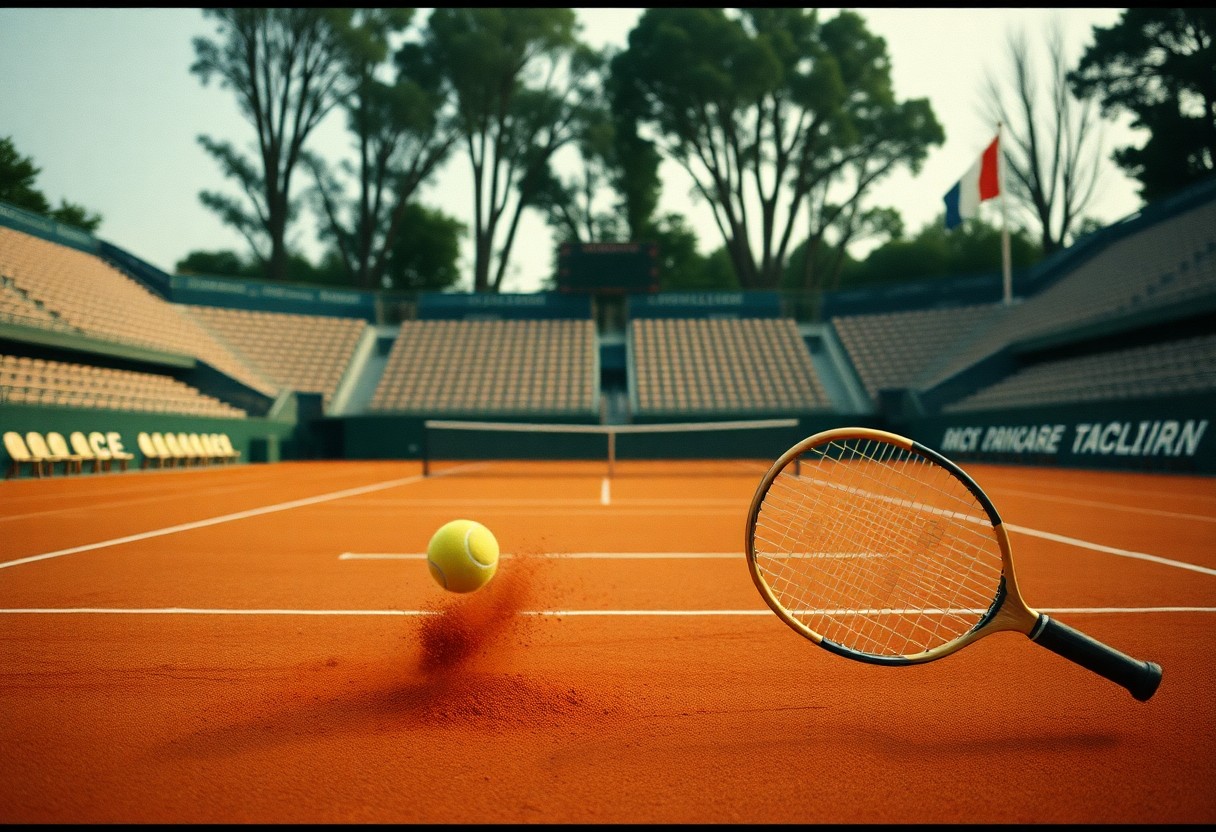
Roland Garros’ surface uses a crushed‑brick topcoat that produces a slow court with high, spin‑friendly bounce, favoring baseline grinders and heavy topspin-Rafael Nadal’s 14 French Open titles exemplify mastery on this substrate; maintenance focuses on daily rolling, precise watering and periodic rebricking to maintain uniformity and predictable sliding.
Green Clay
Har‑Tru, made from metabasalt, yields a firmer, slightly faster playing surface with a lower bounce and quicker drainage, common in U.S. clubs and events like Charleston; players often shorten swings, attack with flatter strokes, and benefit from quicker transition to offense while adapting movement to reduced slide depth.
After years of club use and tournament testing, green clay’s durability and faster drying times make it a practical alternative where seasonal rain or quick court turnaround are factors.
Factors Contributing to Roland Garros’s Legacy
Various elements combine to sustain Roland Garros’s reputation: the red clay surface that slows play and magnifies topspin, the stadium born in 1928, and iconic performances like Rafael Nadal’s 14 French Open titles. Maintenance rituals and match scheduling intensify endurance demands, shaping champions. Assume that this unique mix of surface physics, infrastructure and historic triumphs continues to define its legacy.
- Roland Garros
- red clay
- Grand Slam
- Rafael Nadal
- 1928
Historical Significance
Rooted in the 1891 French Championships and opened to international competition in 1925, Roland Garros evolved into a global benchmark; the stadium completed in 1928 and the Open Era’s 1968 expansion cemented its status as the only clay-court Grand Slam. Generations of champions and landmark matches have turned it into a cultural touchstone for French sport.
Unique Tournament Features
Red clay’s crushed-brick top-dressing produces a slower, higher-bouncing ball and visible marks that influence officiating; Court Philippe-Chatrier holds about 15,000 and gained a retractable roof in the 2019-2020 renovations, enabling night play and faster recovery from rain. Sliding technique and endurance become decisive factors.
Grounds crews water and roll courts daily, applying brick dust to tweak traction and bounce, which lengthens rallies and rewards stamina; serve speeds typically fall versus hard courts, letting topspin-heavy players dominate. The surface imposes a physical toll-long rallies and sliding increase muscular strain-while producing tactical variations and match narratives unique to Roland Garros.
Pros and Cons of Playing on Clay
Clay changes match dynamics: it slows the ball, raises bounce, and magnifies topspin, producing longer rallies and demanding superior footwork and point construction. Players with patient baseline games often gain an edge, while big servers and volleyers see their weapons blunted. Tactically, clay rewards endurance, sliding technique, and shot tolerance, but it also increases cumulative wear and requires specific equipment and preparation.
Pros and Cons
| Pros | Cons |
|---|---|
| Slows pace and rewards heavy topspin | Reduces ace frequency; big servers lose edge |
| Creates longer rallies for tactical depth | Matches often exceed three hours, raising fatigue |
| Favors baseline defenders and counterpunchers | Punishes aggressive serve-and-volley styles |
| Develops sliding and court coverage skills | Increases stress on knees, ankles and tendons |
| Allows more effective recovery between points | Sliding raises risk of acute slips and soft-tissue injuries |
| Promotes strategic point construction | Requires long adaptation periods in training |
| Rewards topspin-heavy weapons | Clay buildup affects ball and shoe performance |
| Levels playing field for specialists | Short clay season limits mastery opportunities |
Advantages for Players
Players who thrive on clay often exhibit elite endurance, slide mechanics, and topspin production; Rafael Nadal’s 14 Roland Garros titles exemplify how those traits convert to dominance. Longer rallies reward those who construct points-using deep, heavy forehands and patient backhands-while defenders can turn defense into offense. Additionally, clay softens landing impact compared with hard courts, allowing tactical recovery between points and extending rally-based strengths for specialists.
Disadvantages for Players
Clay’s demand for prolonged rallies and sliding imposes higher cumulative load: tendons, knees and ankles face increased repetitive stress, and players frequently endure matches beyond three hours, which elevates fatigue and overuse risk. Serve effectiveness falls, forcing big servers to alter tactics, and equipment must cope with clay accumulation that changes ball behavior and shoe traction.
On a deeper level, adaptation is both technical and calendar-based: the European clay swing is roughly eight weeks, so players must reshape timing, fitness and footwork to peak. Historical examples underline this-Pete Sampras never captured Roland Garros, highlighting how surface style can block great champions, while others (e.g., Federer’s 2009 win) show that targeted adjustments and scheduling can overcome those disadvantages.
Tips for Success at Roland Garros
Mastering clay demands heavy topspin, superior footwork and endurance; Roland Garros rewards players who extend rallies and use angles-Rafael Nadal’s 14 titles are the prime example. Expect matches to often exceed three hours and plan nutrition, recovery and on-court tactics accordingly. The combination of intense footwork drills, heavy topspin practice and match-simulation on red clay separates contenders.
- Sliding: practice controlled slides and rapid recovery steps.
- Topspin: focus on high-bounce forehands and heavy crosscourt angles.
- Endurance: simulate 3-hour match scenarios in training.
- Point construction: work on patience, resets and drop-shot execution.
- Equipment: choose clay-tread shoes and tweak string setup for bite.
Training Recommendations
Prioritize two-a-day sessions: a 60-90 minute morning aerobic or interval set and a 60-90 minute afternoon clay-specific block emphasizing 200-300 topspin reps, slide drills and point-play patterns; introduce weekly 3-hour practice matches to replicate Roland Garros intensity and recovery demands while tracking heart rate and glycogen intake for consistency.
Match Preparation Strategies
Arrive 90 minutes early, complete a 20-25 minute dynamic warm-up, then 15-20 minutes of progressive hitting finishing with 10 targeted serves and break-point scenarios; monitor court moisture and adjust tactics-use higher bounce to attack short balls and shorten points when the surface is heavy. The focus on pre-serve routines, tactical checklists and hydration limits mid-match mental drift.
In wet or tacky conditions, reduce risk by selecting clay-specific soles, taping vulnerable ankles and prioritizing first-serve percentage over sheer power; simulate late-set pressure with tie-break drills and practice converting 40-0 leads under fatigue-studies and pro routines show players who rehearse these scenarios convert a higher percentage of critical points and avoid momentum swings caused by unforced errors.
Step-by-Step Analysis of Clay Court Play
| Phase | Key Actions & Effects |
|---|---|
| Movement & Footwork | Slide-first recovery, low hips, and timed split-steps create court coverage; longer rallies (often 6-8+ shots) force players to manage energy and balance. Emphasize controlled slides and short, explosive pushes to regain position while accepting that deceleration on clay alters stroke setup. |
| Shot Selection & Strategy | Prioritize heavy topspin to exploit high bounce, mix in drop shots and low slices to change rhythm, and construct points over multiple shots. Case study: Nadal’s 14 Roland Garros titles show relentless topspin plus selective aggression to shorten rallies. |
Movement and Footwork Techniques
Slide-driven transitions define clay movement: players use an initial cross-step into a controlled slide, maintain a low center of gravity, and time the split-step later than on hard courts to handle higher bounces. Coaches teach a two-stage recovery-immediate slide into a short shuffle-so athletes can sustain lengthy exchanges without overcommitting, while being mindful that aggressive slides increase torsional load and the risk of ankle or knee strain.
Shot Selection and Strategy
Clay rewards patience and variety: heavy topspin to push opponents back, well-timed drop shots to exploit depth gaps, and wide-angle rallies to open the court. Serve percentages matter more than raw speed; a high-percentage kick serve that produces a high second-bounce often forces weaker replies, enabling the server to dictate the third shot.
Deeper tactics include constructing points over 3-6 shots to create a short ball-use a pattern of deep topspin to the backhand, then a sharp drop or angled forehand to finish. Elite examples show mixing pace: alternate a 70-80% topspin baseline exchange with a sudden slice or flat drive; this combination increases unforced errors from opponents and maximizes the clay premium on patience and placement.
The Future of Roland Garros
Post-2019 renovations consolidated Roland Garros’ place in modern tennis: the addition of a retractable roof on Philippe-Chatrier and preserved 1928 façade balance heritage with adaptability, while scheduling flexibility and enhanced broadcast infrastructure prepare the event for climate variability and global audiences without sacrificing its identity.
Innovations and Changes
Philippe-Chatrier’s roof, completed during the 2015-2019 works, enabled reliable play during rain delays and supported the introduction of more night sessions; the 2019 insertion of Court Simonne-Mathieu (≈5,000 seats, botanical garden setting) and wider use of electronic line-calling and player-tracking mark targeted modernization that keeps the tournament competitive on TV and streaming markets.
Maintaining Tradition and Heritage
Preservation efforts keep the red clay surface and sliding culture central: stadium naming (after aviator Roland Garros) and the 1928 Art Deco elements remain intact, while examples like Rafael Nadal’s 14 titles underscore how the surface still defines champions and tactics at Roland Garros.
Groundskeepers work around the clock during the fortnight, applying a seasonal top layer of crushed brick (about 3-4 cm), daily watering, rolling and raking to ensure consistent bounce and slide; these routines directly affect player safety and performance, so traditional maintenance is treated as a technical, high-priority operation rather than mere ceremony.
To wrap up
Drawing together the tournament’s century-old traditions, distinctive clay surface, iconic champions and ongoing innovations, Roland Garros endures as the preeminent clay-court championship. Its historical milestones and tactical demands have reshaped playing styles and tennis culture, forging a legacy that continues to influence athletes, equipment and tournament standards around the world.
FAQ
Q: What historical developments established Roland Garros as the preeminent clay-court Grand Slam?
A: The tournament traces its lineage to the French Championships of the late 19th and early 20th centuries and moved to the purpose-built Stade Roland Garros in 1928, giving it a stable, iconic home named after the aviator Roland Garros. Opening to international competition in the 1920s and consistently staging premier-level play through wars, political change, and tennis’ professionalization cemented its global stature. Its status was reinforced by a consistent identity as the only Grand Slam played on natural red clay, landmark matches and rivalries that defined eras, and the festival-like Parisian setting that fused national pride with international appeal. Over decades the tournament balanced tradition with modernization-upgraded stadiums, a museum, and selective infrastructure investments-preserving prestige while adapting to contemporary professional tennis.
Q: How does the clay surface at Roland Garros affect match play and which players benefit most?
A: Red clay slows the ball and produces a higher, more irregular bounce, extending rallies and rewarding heavy topspin, patience, and footwork for effective sliding. Matches tend to be more physical and tactical, favoring baseline grinders who excel at constructing points, changing pace, and defending. Serve-dominated styles are neutralized relative to faster surfaces, so players with endurance, spin production, and variety-drop shots, angles, and consistent depth-gain advantage. Weather and court maintenance further influence conditions: dry heat quickens play and increases bounce, while damp conditions make courts heavier and even more taxing. Equipment choices (string tension, shoe tread) and movement technique specific to clay also shape outcomes.
Q: In what ways has Roland Garros influenced tennis culture and the development of players worldwide?
A: Roland Garros has become the definitive test of clay-court mastery, shaping training emphases in Europe and South America and producing specialists who carry clay-born tactics to other surfaces. Its history of epic performances and recurring champions has created benchmarks for greatness and inspired generations of coaches and players to prioritize endurance, point construction, and topspin. Institutionally, the event set standards for stadium design and fan experience among clay tournaments, while innovations such as stadium renovations and the addition of a roof have helped sustain its global broadcast appeal. Culturally, its Parisian backdrop, passionate crowds, and integration of national heritage into the event have amplified tennis’ profile in France and worldwide, ensuring that success there is widely regarded as a defining achievement in a player’s career.