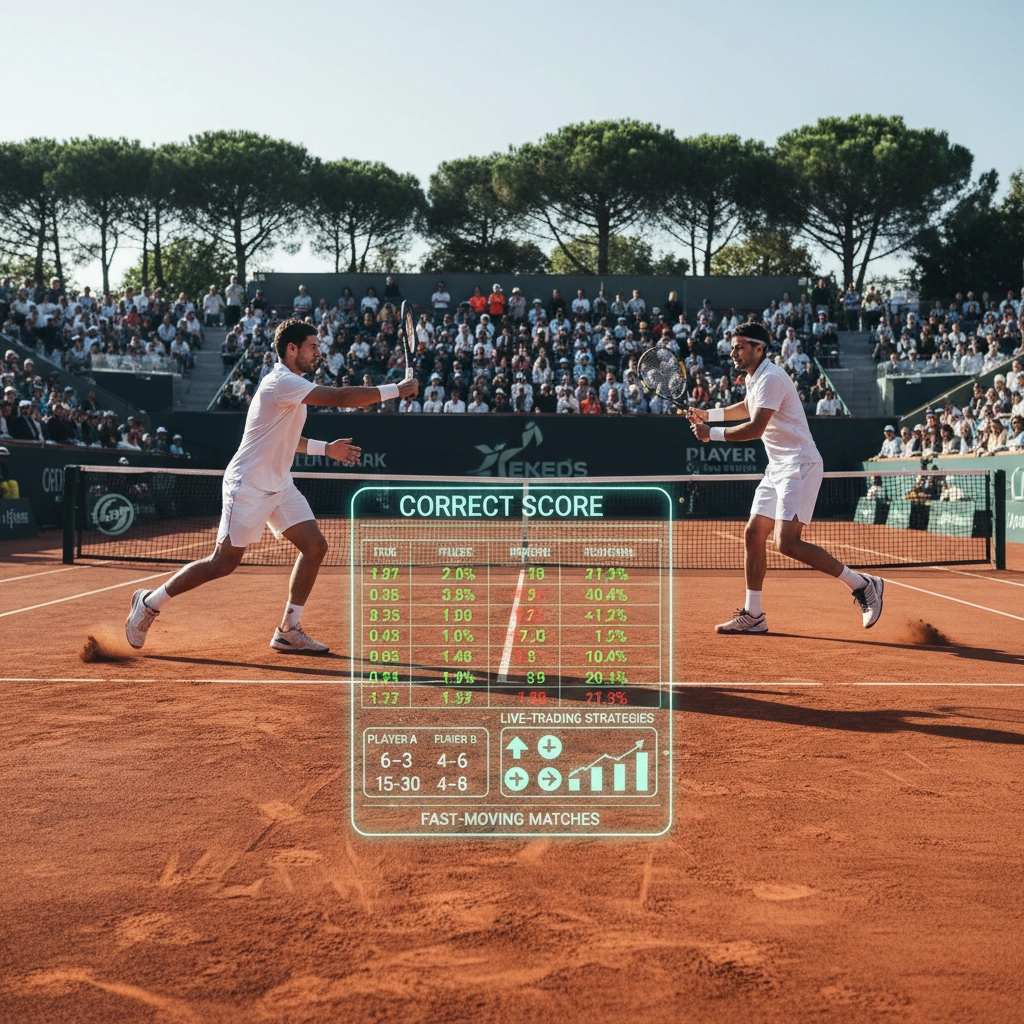
Why correct-score trading in tennis demands split-second decisions
When you trade correct-score markets in tennis, you’re handling one of the most reactive betting environments. Each point can swing probability dramatically: a returned serve, a double fault, or a sudden medical timeout changes how the market prices every possible final score. Because correct-score markets pin a final set or match score rather than just a winner, they compress outcome space and amplify volatility. That volatility creates opportunities — and risk — for traders who can read the match and act fast.
In fast-moving matches you’ll find that price gaps form quickly after pivotal moments. Those gaps are where traders make money, but only if they’ve prepared in advance and keep stake management and execution discipline. This section explains the market behaviour and the practical early steps you should take before and during the opening stages of a match.
How in-play correct-score markets behave and what to watch first
- High sensitivity to serve breaks: A single break of serve often shifts probabilities for multiple correct scores simultaneously. If you trade set-correct scores, the effect is compounded.
- Momentum clusters: Runs of points (e.g., 3–4 games in a row) create short windows where prices skew, offering value on scores that the market hasn’t fully adjusted for.
- Liquidity hotspots: Tiebreaks, deciding sets, and early sets between evenly matched players usually concentrate liquidity. In quieter matches, prices can be jumpy and slippage bigger.
- Surface and match-up sensitivity: Fast surfaces reduce break frequency and compress probabilities toward serve-dominant scores; clay encourages more breaks and wider spreads.
- Event-driven spikes: Injuries, code violations, or weather delays create abrupt repricing — either an opportunity to capture mispriced odds or a reason to reduce exposure.
Pre-match and opening-game practical actions for live traders
Before the first ball you should define a clear plan: which correct-score markets you’ll target (final match score, set-by-set), your maximum exposure, and immediate exit rules. Prepare by checking head-to-heads, recent form on surface, and serve/break percentages — these stats determine the baseline distribution of likely scores.
At the opening games, focus on quick indicators rather than trying to re-evaluate everything: the first service holds, early break chances saved, and player movement. Price reactions in play often lag a couple of points; if you’re watching closely you can anticipate the market’s next adjustment and place orders slightly ahead of consensus. Keep stakes conservative until the market confirms a trend or a clear misprice appears.
With those basics covered, you’ll be ready to move from reading market structure to executing concrete live-trading tactics — next we’ll examine specific order types, stake-sizing approaches, and real-time signals that let you capture value in the split seconds after pivotal points.
Order types and execution techniques for lightning-fast markets
When the market is moving point-by-point, the choice and timing of orders matter as much as the trade idea. Limit orders let you hunt for value on a mispriced correct score without immediate slippage, but they can miss when prices gap. Market (or aggressive) orders guarantee execution but often at a worse price — in fast matches that difference can turn a small edge into a loss.
- Use layered limit orders: Place a primary limit at the level you want and a smaller, secondary limit one or two ticks worse to catch partial fills if the market squeaks. This preserves price while increasing fill probability.
- Pre-place contingent orders: Where the platform allows, pre-place opposing trades to auto-hedge once a score changes (e.g., a back of 6–4 if the score moves to 4–4). This reduces reaction latency when the market re-prices.
- Keep a fast cancel rule: If you don’t fill within one or two points that materially alter the state (an opponent break or medical stoppage), cancel and reassess. Stale orders are a common source of surprise fills.
- Exploit micro-ladders for scalps: In liquid matches use ladder trading to lay/back adjacent scores to “green up” across outcomes as games unfold. This is especially effective around tiebreak-sensitive scores where the market crowd hesitates.
Execution discipline: prefer passive entry when you expect drift and aggressive entry when you want certainty through a volatile juncture (a sudden break or set point). Always monitor order book depth — large resting volume at a price is often a clue the market will bounce off that level.
Stake-sizing and exposure limits for high-volatility correct-score bets
Volatility demands strict bankroll rules. Correct-score outcomes are binary and skewed — many high-odds prices look attractive but will lose frequently. Define exposure per market, per match, and per event type ahead of time.
- Fractional sizing: Use small unit sizes: 0.5–2% of your bankroll per single correct-score position depending on confidence and liquidity. Reduce size for low-liquidity matches or when relying on prediction over market flow.
- Aggregate exposure caps: Cap total liability to a conservative percentage (e.g., 3–6% of bankroll) across all correct-score lines in a match. This prevents large correlated losses when the market reprices broadly after a swing.
- Scaling in and out: Start with a partial position (50–75%) and add only if the market confirms your read (a second consecutive break, clear physical drop in serve speed). Exit in layers: lock profits on a portion once the market moves in your favour, then trail the rest.
- Stop-loss discipline: Use predetermined stop-loss thresholds relative to your entry price (e.g., 20–40% adverse move on odds) rather than emotion-driven exits — adjust thresholds for liquidity and tick size.
Real-time signals and quick-read cues that justify a trade
Successful split-second traders rely on a short checklist of actionable signals rather than opinion-based narratives. Watch for converging cues that validate a rapid trade.
- Serve metrics changing live: A consistent drop in first-serve percentage or average serve speed over three service games often precedes an increased break probability — price misalignments appear quickly.
- Momentum and compact runs: Two or three games in a row from the same player — especially when combined with dominant point-win rates (e.g., >70% on return points) — create windows to back score lines that benefit from continued runs.
- Order-book anomalies: Sudden removal of volume at a price or a flood of new offers is a red flag for imminent repricing. Conversely, heavy buy-side volume at a less-likely score signals crowd conviction you can fade with a layered entry.
- Event triggers: Medical breaks, timeout, visible fatigue, or code violations — these cause abrupt shifts. Either tighten exposure or increase aggression to capture the temporary mispricing, depending on how the signal aligns with your model.
Combine these signals with disciplined execution and sizing: a single strong cue rarely justifies a large position, but two or three aligned signals create the high-probability moments where split-second correct-score traders earn edges.
Practical in-play checklist
- Predefine stake size and maximum aggregate liability for the match before the first serve.
- Watch the first two service games to validate serve-speed and first-serve metrics; delay larger entries until you see reliable patterns.
- Prefer layered limit orders with a small secondary peg to improve fills; use aggressive orders only when certainty outweighs price slippage risk.
- Pre-place contingent hedges where platform functionality allows; cancel stale orders after one or two decisive events (breaks, medical timeouts).
- Only scale in after two or more aligning signals (serve drop, momentum run, order-book shift); scale out in layers once the market moves in your favour.
- Log every trade and review post-match — focus on execution errors (missed fills, late cancels) as much as selection mistakes.
Operational mindset for fast matches
In lightning-fast correct-score trading, your edge is not just the model you use but the rigour you apply to execution, sizing and review. Treat each match as a series of micro-decisions: limit avoidable risk, act decisively when converging cues appear, and insist on a repeatable process for entries and exits. Over time, small improvements in reaction time, order placement and discipline compound into measurable gains. For deeper event-level stats to inform pre-match bias, consult a reliable live-stats resource such as Tennis Abstract.
Frequently Asked Questions
How should I size stakes for correct-score trades in volatile matches?
Use fractional sizing: typically 0.5–2% of your bankroll per position depending on liquidity and confidence. Cap aggregate exposure across all correct-score lines in a match (common range 3–6% of bankroll) and scale in only after confirming signals to avoid oversized losses from quick reprices.
When is it better to use limit orders versus market orders during live trading?
Use limit orders to preserve price when you expect drift or want a favourable fill; add a secondary limit a tick or two worse to improve fill chances. Use market (aggressive) orders when certainty and immediate execution matter more than price — for example, to lock a hedge after an unexpected break — accepting potential slippage.
Which live signals reliably justify a fast correct-score trade?
Look for converging cues: a sustained drop in first-serve percentage or serve speed across service games, compact momentum runs (two–three games) combined with dominant point-win rates, and clear order-book anomalies (sudden removal or influx of volume). One signal alone warrants caution; two or more aligned signals create higher-probability trading windows.