US Open hard-court specifics and why New York conditions shape match tactics
The US Open hard-court is a defining feature of late-summer tennis in New York, and understanding its composition, ball behaviour and local climate helps players and fans read matches more clearly. This article examines the acrylic hard-court characteristics used at the US Open, how the ball reacts, the influence of New York weather and the official balls employed, with a focus on how these factors drive tactical choices on serve, return and point construction.
What the surface actually is and how it affects play
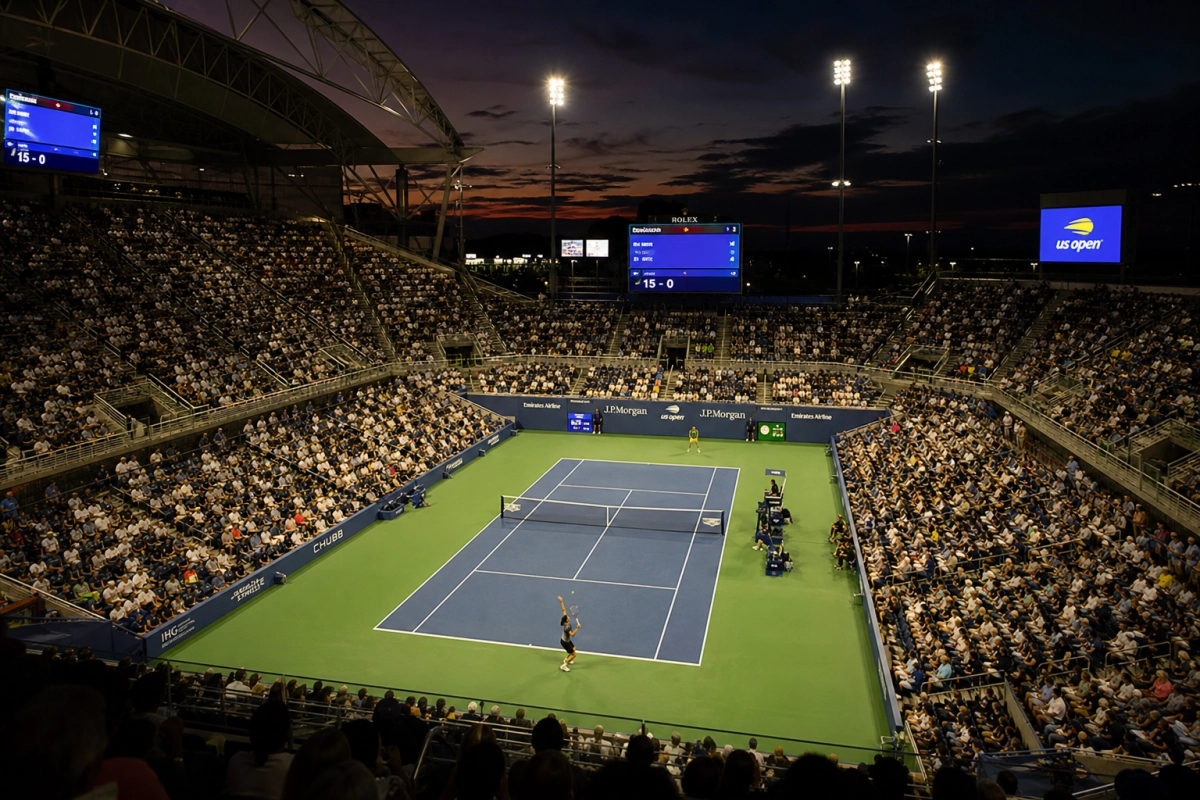
The US Open is played on a multi-layered acrylic hard court applied over a concrete or asphalt base. These systems combine a firm playing base with acrylic layers that include cushioning, textured topcoats and paint. The result is a court that is generally classified between medium and medium-fast in pace compared with clay and grass.
Key practical effects for players include consistent, relatively high and predictable bounces, clear footing for lateral movement, and a surface that rewards flat, penetrating shots as well as aggressive movement into the court. The firmness favours players with strong serves and powerful, early ball-striking, but the textured topcoat still allows for some spin to be effective.
Surface maintenance and court-to-court variation
Even within a single tournament, small differences in wear, topcoat refreshment and underlying slab temperature can change speed and grip. Courts in show stadiums are re-coated and cleaned regularly, producing slightly different playability from outer courts that see less maintenance. Players and coaches should expect and adapt to these micro-variations during practice sessions.
Ball behavior: bounce, pace and interaction with spin
Balls on US Open courts bounce higher than on grass but lower than on clay; the bounce is firm and predictable, which benefits players who take the ball early. Pace off the court is relatively fast, so aggressive serves and flat groundstrokes carry through the court and win quick points.
Spin remains an important weapon: topspin raises the bounce and pushes opponents back, while slice stays low and can be used to change rhythm. The combination of predictable bounce and moderate-to-fast pace means players who can vary depth, spin and pace often force more unforced errors from opponents.
Official balls and their practical effect
The US Open uses tournament-approved competition balls supplied by the official provider. These balls are constructed to offer consistent pressure retention and durability through long matches. Players should expect slightly livelier first-sets with newer balls and marginal slowing as balls scuff — this influences when to attack and when to extend rallies.
How New York weather and scheduling alter match dynamics
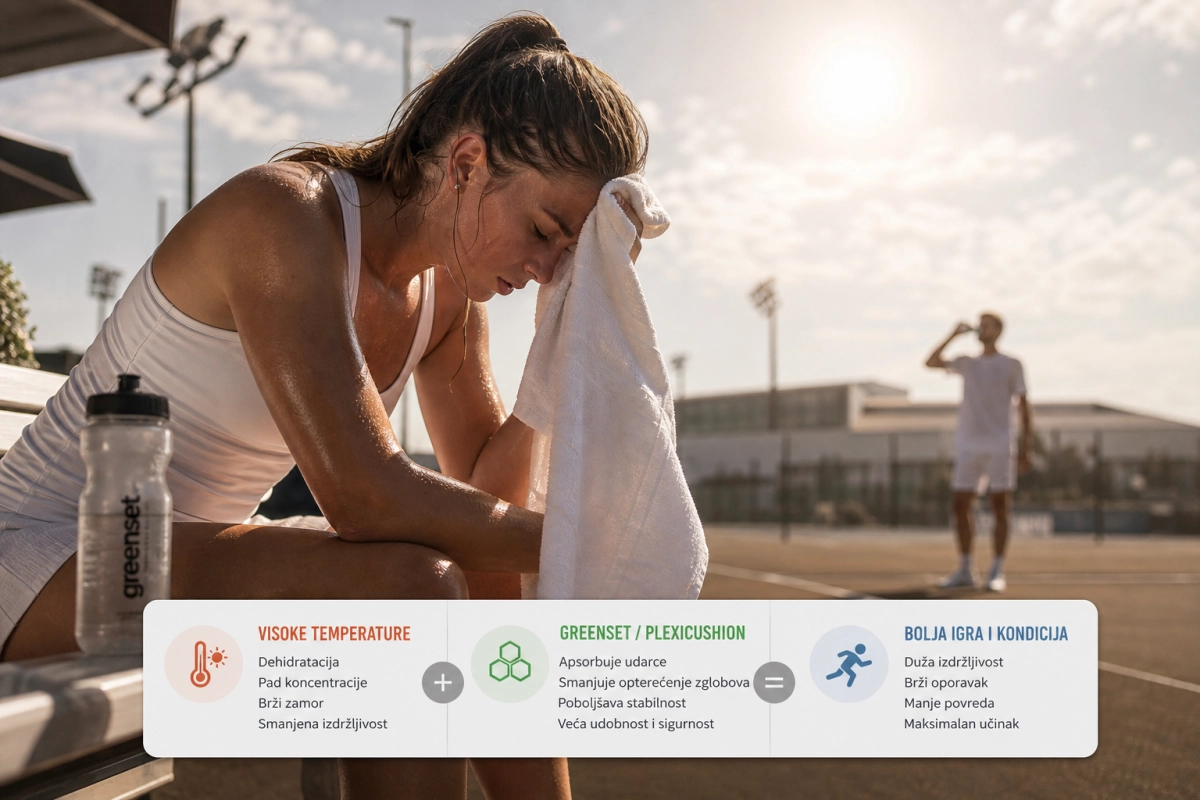
Late-summer conditions in New York — heat, humidity and occasional wind — significantly affect ball flight and player endurance. Higher temperatures make balls livelier and the court a touch faster; humidity can weigh balls down and reduce bounce slightly. Evening matches cool down, changing ball behaviour and requiring quick tactical adjustments.
Wind is a factor mostly on outer courts; stadiums like Arthur Ashe offer some shelter but not complete protection. Players must adapt serve placement and spin to cope with gusts, and coaches should plan warm-ups that simulate likely court and weather conditions.
With these surface, ball and weather fundamentals established, the next section will translate them into concrete tactical adaptations, detailed serve and return patterns, and specific training and equipment recommendations for competing at the US Open.
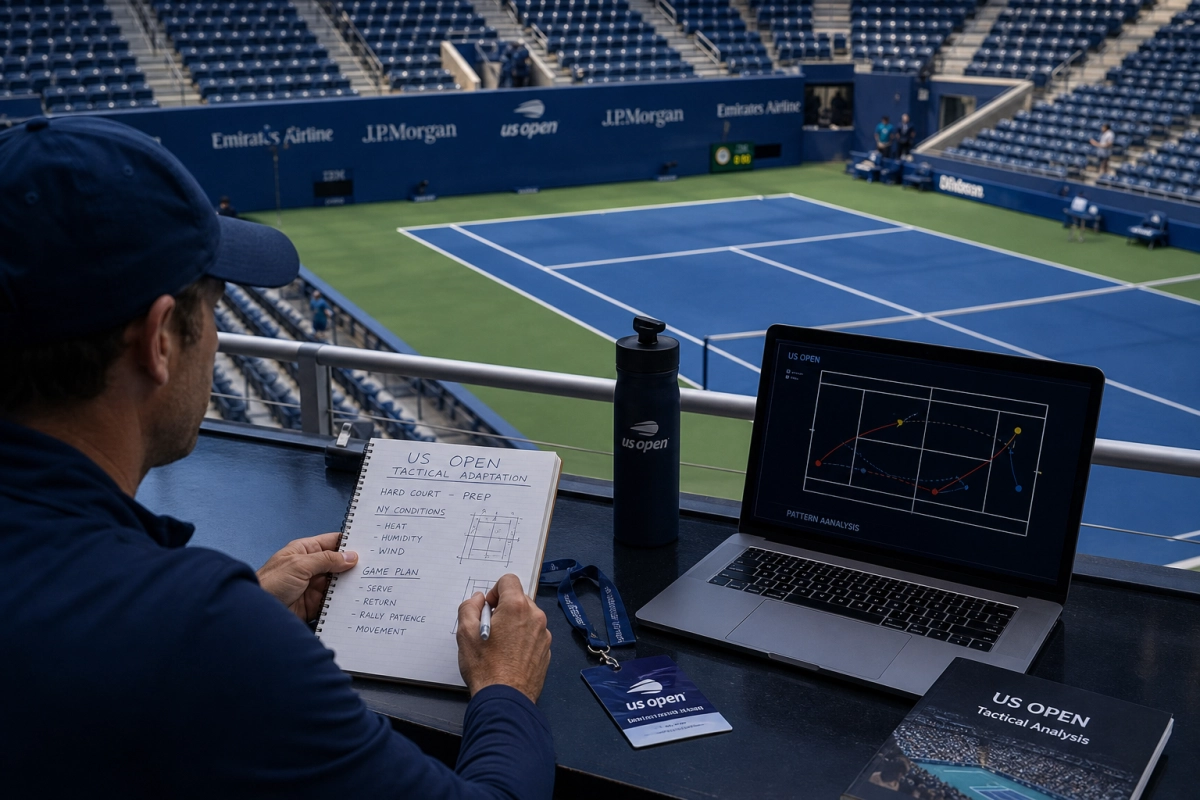
Tactical adaptations: point construction, court geometry and tempo control
Players who succeed at the US Open combine aggressive intent with controlled variation. The court’s predictable, medium-fast pace favors taking the ball early and redirecting pace, so point construction should prioritize depth, first-strike aggression and timely change of rhythm.
– Serve to set up patterns, not just to win free points. A well-placed serve that forces a weak return allows the server to take the ball early and finish the point with one penetrating stroke. Use wide serves to pull opponents off the court and create angles for follow-up forehands; use body serves to jam attackers and open the crosscourt for short-angle responses.
– Neutralize rhythm with depth and spin changes. After a deep, penetrating rally ball, mix in a short slice approach or a heavy kick to alter bounce height and timing — this frequently produces short replies on an acrylic court.
– Transition selectively. The surface gives reliable footing for approach shots, but because balls carry through, players should only move aggressively forward when the approach is deep and low. Favor inside-out or inside-in drives after wide serves to create the space needed for a high-percentage approach.
– Control tempo to exploit stamina and wind. In humid, hot conditions, lengthening points with deliberate variation (slices, drop shots, widening angles) can sap opponents who rely on flat power. Conversely, in cooler evening conditions when balls sit up less, shorten the point with flatter winners and first-strike serving.
Concrete serve and return patterns for match play in New York
Below are practical, repeatable patterns tailored to right- and left-handed interactions and common match scenarios on US Open courts.
Serving (right-hander examples)
– Deuce court, first serve: wide flat serve to opponent’s backhand → immediate inside-out forehand to open court (drive the opponent long or off the court).
– Deuce court, second serve: high-kick to forehand side (or body for aggressive returners) → step in early on the next ball or run around for forehand.
– Ad court, first serve: slice serve out wide to pull opponent off the court → approach to the shorter side or drive the line.
– Ad court, second serve: dependable kick to the T to reduce angles and buy time for return coverage.
Returning
– Aggressive return vs medium first serve: step in and punch deep to the server’s backhand corner; aim low over the net to force a defensive reply.
– Neutral/block return vs big serve: slice return back to the server’s feet or crosscourt at minimal pace to force a short third ball.
– Chip-and-charge on second serves: short, low slice to the opponent’s feet followed immediately by an aggressive forward step and approach shot.
– Against heavy kick serves: attack the shorter ball inside the baseline with a heavy topspin drive to push the server back.
Training drills and equipment recommendations specific to US Open conditions
Drills
– High-bounce feeding: practice handling above-shoulder balls with early contact and compact preparation (10–15 minute blocks).
– Serve-target rotation: place cones in wide and T positions and run alternating serve sequences (first-serve focus 40 reps each spot, second-serve kick/slice 40 reps).
– Return-simulator: partner or machine feeds varied pace (flat, kick, slice) from realistic depths; practice punch, block and chip-and-charge responses.
– Heat and night simulation: schedule mixed-condition sessions (hot mid-day and cooler evenings) to rehearse string tension, footwear feel and ball behavior changes.
Equipment
– Strings: consider a hybrid setup—polyester mains for control and spin, softer crosses for dwell and comfort; drop 2–3 lbs of tension in hotter spells for more liveliness.
– Shoes: durable hard-court outsoles with reinforced toe and responsive cushioning for quick lateral work.
– Ball selection in practice: use balls of similar felt and pressure to the tournament provider; rotate practice balls to replicate mid-match scuffing.
These tactical patterns, practice habits and gear adjustments help players translate surface knowledge into on-court advantage during US Open conditions.
Matchday checklist for players and coaches
- Walk several courts on arrival to note surface sheen, debris and visible wear; choose warm-up court that matches match court when possible.
- Confirm string tension and have a backup racquet tuned for expected temperature and humidity.
- Run targeted warm-up feeds: serves to planned targets, returns to each zone, and several high-bounce rally reps.
- Set clear serve/return plans for first and second serves, with one fallback pattern if wind or opponent adjustments force change.
- Prepare footwear and tape options for sliding or sticky patches; brief the team on hydration and cooling strategies for heat and humidity.
- Agree on simple in-match communication signals for tactical shifts (e.g., add kick serves, shorten points, attack returns).
In-match cues to monitor and react to
- Ball carry and height: if balls begin to sit up, attack earlier; if they skid, flatten out and shorten the swing.
- Bounce consistency across courts and positions—adjust approach timing if certain areas produce atypical kicks or lower bounces.
- Opponent footwork and recovery speed—lengthen points if movement breaks down or shorten them if opponent is firing clean winners.
- Wind patterns between changeovers—re-check serve target choices and toss direction as conditions shift.
- Ball condition during a match—take advantage of fresh-ball liveliness early and exploit scuffed balls later for controlled depth.
Putting knowledge into practice
Knowing the specifics of New York hard-court play is only useful when it informs concrete choices on court. Treat each session and match as an opportunity to test one tactical change, observe the outcome, and make small, measurable adjustments. Maintain curiosity about subtle environmental shifts, protect physical readiness with appropriate gear and routines, and prioritize simple, repeatable patterns that free decision-making under pressure. Over a tournament week, those incremental applications and disciplined observations—not grand overhauls—are what convert surface understanding into better match results.