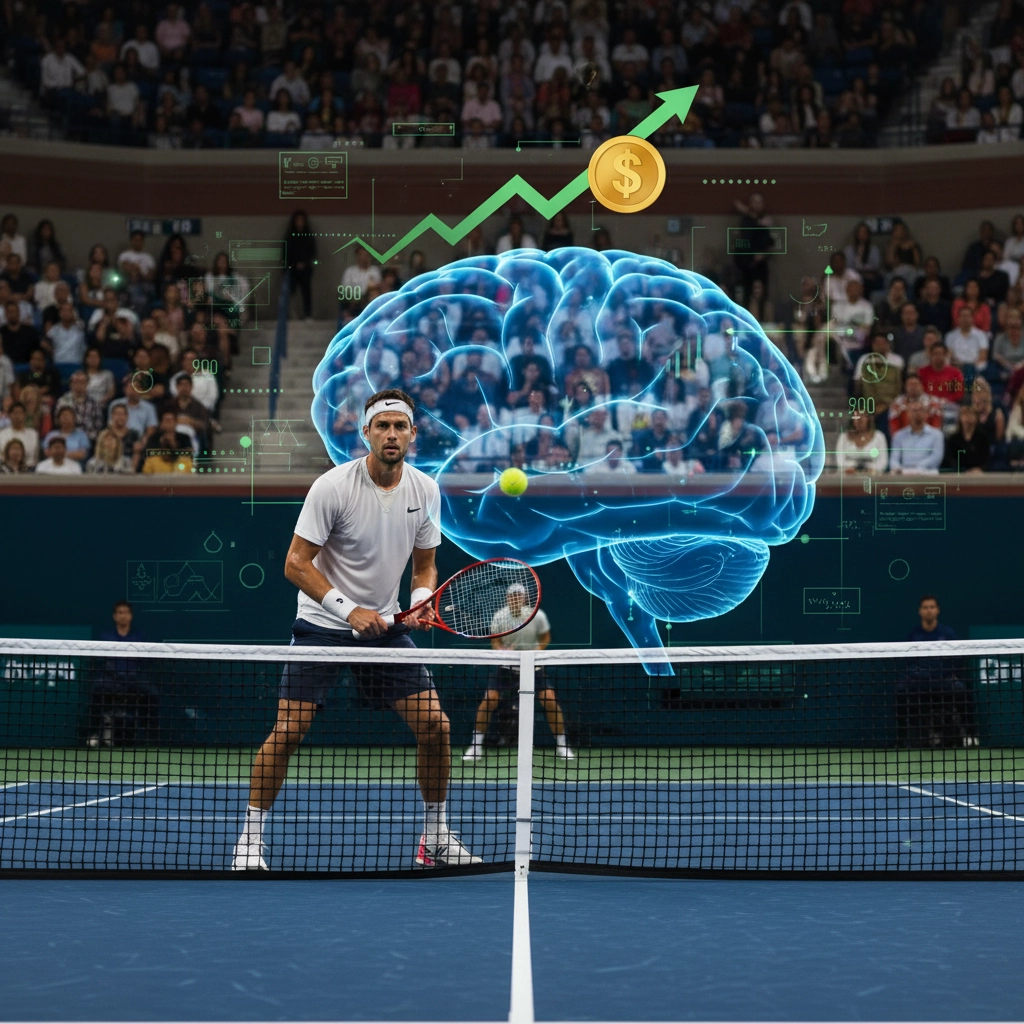
Why player mindset can shift the odds before the first serve
You can analyze rankings, head-to-head records, and surface statistics, but the mental state of each player often tilts the outcome in ways pure numbers don’t capture. Mindset affects decision-making under pressure, risk tolerance on key points, and the ability to maintain a game plan when conditions change. For prediction purposes, that means a player’s psychology can create value opportunities you’ll miss if you rely only on form and stats.
Bookmakers and sharp bettors alike adjust lines when a player’s mental advantage or disadvantage becomes apparent. A confident player who thrives in big moments will typically be favored more than raw talent suggests. Conversely, an anxious or distracted player can underperform relative to their ranking. Learning to spot the psychological edge helps you interpret odds movement and improve your prediction accuracy.
Early, observable signs that reveal a player’s mental state
On-court cues and pre-match behavior you can use
Before you place a prediction, use visible signals to assess temperament. These cues are not definitive on their own, but together they form a pattern:
- Warm-up intensity: A focused, rhythmic warm-up often signals readiness; excessive nervousness or passive drills can indicate doubt.
- Body language: Closed-off posture, frequent staring at the ground, or visible frustration during practice points may foreshadow lapses in composure.
- Interactions with team: Calm, concise communication with coaches and physios suggests a stable routine; heated exchanges or repeated checking of equipment can point to underlying stress.
- Pre-match routines: Players who stick to familiar rituals usually maintain consistency under pressure; departures from ritual can indicate distraction.
Statistical and contextual indicators of mental strength
You should combine observational cues with quantitative measures to form a balanced view. Key stats that reflect mental tendencies include:
- Break-point conversion and save percentages: Consistently high numbers in clutch moments indicate mental resilience.
- Tiebreak records: Players who win tiebreaks more often than expected tend to handle stress better.
- Performance swings after long matches: Look for trends where a player fades or improves in tournaments — fatigue interacts with mindset.
- Head-to-head psychological patterns: Some matchups consistently trigger underperformance from a particular player because of style or history.
As you combine these qualitative and quantitative signals, you’ll start to see how mindset alters probability in practical ways. Remember that mindset is fluid: what looked reliable in one tournament may change with personal circumstances, travel fatigue, or sudden loss of confidence. In the next section, you’ll learn how bookmakers and predictive models attempt to quantify these psychological factors and how you can incorporate them into your own forecasting to find edges in the market.
How bookmakers and predictive models quantify psychological factors
Bookmakers and quantitative models don’t guess at mindsets; they translate observable proxies into adjustments to probability. That translation happens in three main ways:
– Market signals and information flow: Sharp money, sudden volume spikes, and line movement often reflect collective judgment about off-court news or mental state — e.g., a late withdrawal rumor, coach issues, or a player visibly struggling during practice. Bookmakers hedge by shifting prices; astute observers infer what the market “knows” about psychology from those moves.
– Proxy metrics in formal models: Because mindset is latent, models use measurable proxies. Typical proxies include recent tiebreak outcomes, break-point conversion under different scorelines, first-serve percentage on high-leverage points, match length and recovery time (fatigue index), and patterns after momentum shifts (how often a player loses the set after losing a tight set). These features are fed into logistic regressions, Elo-type systems with decay factors, or tree-based models as predictors of match outcomes.
– Dynamic updating and priors: Advanced systems treat psychological signals as priors that update with new evidence. Bayesian frameworks are common: a player’s baseline rating is adjusted when fresh indicators (poor warm-up reports, public comments, travel mishaps) increase the likelihood of underperformance. Live-in-play models incorporate real-time cues — double-fault rates in the opening games, body-language flags from broadcasters, coaching behavior — to reweight probabilities on the fly.
Two caveats: models can only use what’s observable and reliably recorded, and bookmakers price in both hard and soft information (including insider knowledge) quickly. That’s why successful predictors blend hard-data models with persistent, well-documented psychological signals that can be tracked and backtested.

Practical ways to incorporate mindset into your forecasting
You can add psychological factors to your predictions without turning into a full-time psychologist. Use systematic, testable steps:
– Build a psychology feature set: Choose 6–10 repeatable proxies (e.g., tiebreak win rate, break-point save %, average match time in prior week, frequency of double faults in first two service games, travel days since last match). Keep definitions consistent so you can backtest.
– Layer, don’t replace: Start with a reliable baseline model (Elo, logistic regression on surface/form metrics). Add psychological features as additional predictors or as a multiplicative adjustment. For example, a logistic model might output a 60% win probability; then apply a calibrated “mindset adjustment” factor (± few percentage points) based on composite psychological score.
– Backtest and calibrate thresholds: Use historical matches to see how much each psychological feature shifts outcomes and whether adding them improves calibration and sharpness. Convert qualitative observations (warm-up mood, visible limping) into binary flags and test their predictive power before trusting them.
– Live adjustments and rules: For in-play forecasting, preset rules reduce subjectivity: e.g., if first-set tiebreak lost and double-fault count >3 in first 4 return games, lower projected win probability by X%. Having explicit triggers prevents overreaction to single cues.
– Example application: Your model gives Player A a 65% chance. Recent tiebreak losses and three long matches in five days yield a composite mental score that historically reduces win probability by ~6 percentage points versus rested opponents. Adjusted forecast: ~59% — still favored, but the market edge changes and so might your wagering decision.
Common pitfalls and cognitive biases when reading psychological signals
Interpreting mindset invites human error. Guard against these traps:
– Confirmation bias: Don’t cherry-pick cues that fit your hypothesis. Record all observations and run blind backtests.
– Recency and small-sample bias: One bad warm-up or a single tiebreak loss doesn’t define a player. Require multiple corroborating signals or a sustained pattern before making large adjustments.
– Misattribution: Physical issues, jetlag, or strategic resting can mimic mental frailty. Always consider alternative explanations and check for objective evidence (medical updates, travel schedule).
– Overfitting: The more bespoke psychological rules you add, the higher the overfitting risk. Use holdout data and cross-validation to ensure your mindset features generalize.
Mitigation is straightforward: quantify what you can, codify subjective cues into repeatable flags, and test rigorously. Psychology is powerful, but it’s most valuable when treated as another set of validated signals rather than a storytelling overlay.

Applying the framework in practice
- Define your psychology features clearly — e.g., tiebreak win rate (last 12 matches), break-point save % in high-leverage games, and average rest days between matches.
- Automate data collection where possible and turn subjective observations (warm-up mood, equipment checks) into binary flags you record consistently.
- Backtest with holdout periods and simple models first; measure improvements in calibration and betting return before increasing stake sizes on mindset-driven edges.
- Create rigid in-play rules for live adjustments to avoid overreacting — predefine triggers and the exact probability change they cause.
- Keep a journal of predictions and outcomes tied to the psychological signals you used; refine thresholds as sample sizes grow.
Final thoughts on mental edges and probability
Mindset is not a mystical override of statistics — it’s a recurring, measurable influence that, when treated systematically, can tilt probabilities enough to matter. Approach psychological signals like any other feature: define them, test them, and respect their limits. Be skeptical of single observations, protective against bias, and disciplined in applying rules. If you do this, the interplay between psychology and odds becomes a practical tool rather than a storytelling impulse. For additional player data and match context to support your models, consult the ATP Tour player pages.
Frequently Asked Questions
How can I reliably measure a player’s mental state before a match?
Combine observable cues (warm-up intensity, body language, team interactions) with quantitative proxies (tiebreak record, break-point conversion/save rates, recent match load). Convert subjective observations into repeatable binary flags and include them alongside hard metrics so you can backtest their predictive power.
Are bookmakers’ line movements a trustworthy signal of psychological issues?
Line movement is a strong market signal but noisy: it reflects aggregated information, including insider tips and bettor sentiment. Use it as one input — corroborate with on-court observations and your pre-defined psychological features before making substantial adjustments.
Can mindset-based adjustments be backtested effectively?
Yes. Define clear, historically available proxies (e.g., tiebreak outcomes, match length in previous rounds), build models with and without those features, and evaluate improvement in predictive accuracy and calibration on holdout sets. Avoid ad-hoc or retrospective flags that aren’t reproducible.