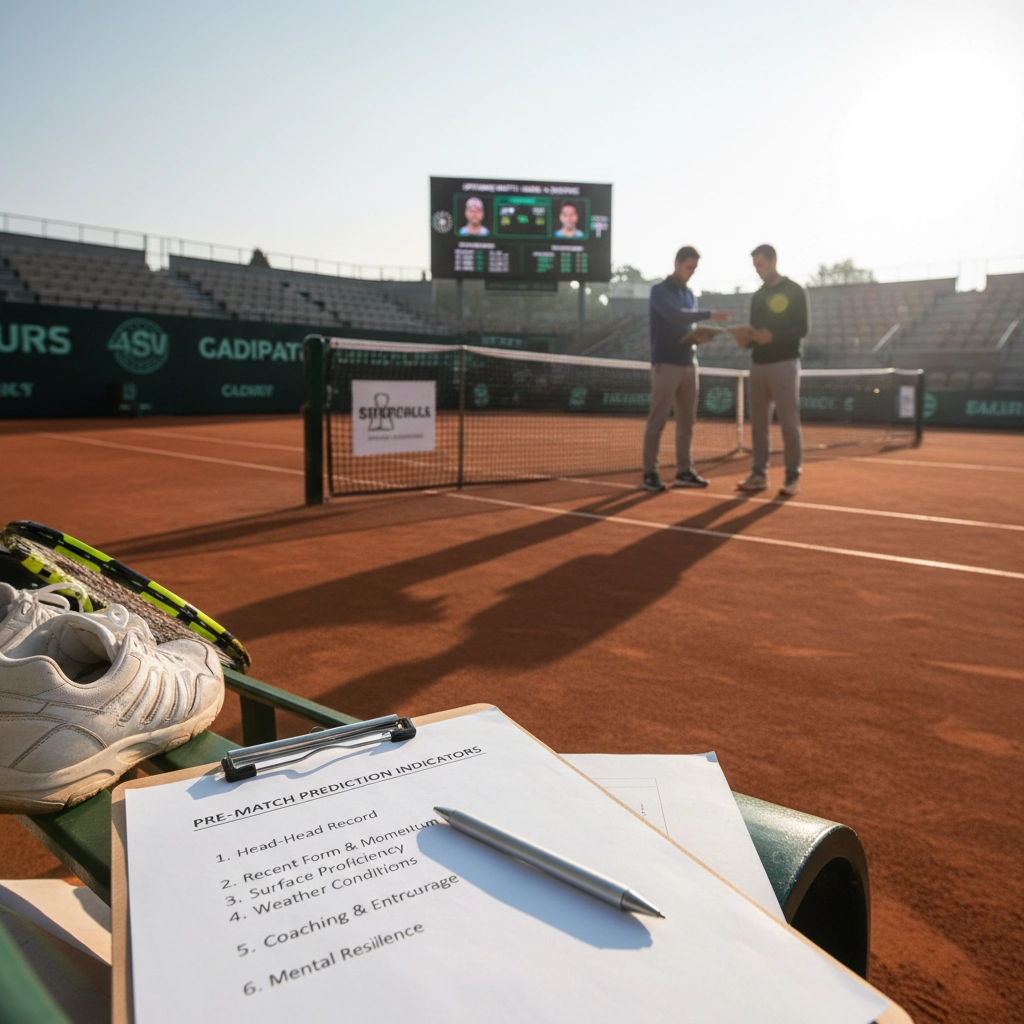
How to read the likely winner before the first serve
You don’t need to wait until the first point to form a sensible expectation about who will win a tennis match. By the time players step onto court, there is already a mass of measurable and observable information that strongly tilts probability toward one competitor. If you learn which indicators carry the most predictive weight, you’ll make faster, more consistent assessments—whether you’re setting a lineup, placing a bet, or just following the tournament with more insight.
Why pre-match indicators matter more than intuition
Intuition and crowd noise are tempting, but they’re unreliable. Pre-match indicators are objective, repeatable, and can be tracked over time. When you combine several independent signals—such as ranking disparity, head-to-head history, and surface-specific performance—you reduce the chance of being misled by short-term variance. Think of each indicator as a piece of evidence: the more pieces that point the same way, the stronger your prediction.
Core performance signals you should check first
Begin with a short checklist before the match. These core signals are quick to access and often explain the largest share of outcome variance.
- ATP/WTA ranking and seeding: Rankings summarize season-long results and are a fast proxy for baseline quality. A clear ranking gap usually favors the higher-ranked player, especially in early rounds.
- Head-to-head record: Past meetings reveal stylistic advantages. If a lower-ranked player consistently beats a higher-ranked one, that pattern is meaningful—especially when matches occur on the same surface.
- Surface-specific form: Players often have big swings between clay, hard, and grass. Check recent matches and win rates on the tournament surface rather than overall form alone.
- Recent match rhythm: Look at the last 4–8 weeks for wins, straight-set defeats, and match fatigue. A player on a winning streak with limited long matches is usually in sharper competitive condition.
Quick practical steps to apply these signals
When you open a match page or tournament draw, run through this mini-process: note the ranking difference, glance at the head-to-head summary, filter recent results by the surface, and flag any long matches or retirements in the past two weeks. If multiple checks favor the same player, your confidence can be higher; if signals conflict, treat the match as more uncertain and look for secondary indicators such as injury reports or travel schedules.
Having established these foundational checks, you’re ready to expand into situational and market-based indicators—like injury news, fatigue, weather, and betting odds—that refine your prediction further in the next section.
Situational factors that can flip pre-match probabilities
Objective stats set a baseline, but match outcomes often swing on situational details that aren’t captured in season-long numbers. These are the things to check last-minute because they can override the core signals.
– Injury and practice reports: Look for withdrawals, medical timeouts from the previous match, reduced-practice notes, or Instagram/posts showing ice and tape. Even a minor tweak to a shoulder or hamstring materially increases the chance of short points and tiebreak losses. Treat late, vague injury reports as asymmetric risk—if a player is listed as “doubtful” or skipped a practice, lower your confidence more than a similar wording would suggest in match summaries.
– Travel, time zone and scheduling stress: Back-to-back long flights, quick turnarounds between tournaments, or an overnight red-eye can reduce serve speed and reaction sharpness. Check where the player came from (and when) and whether they had a day of acclimation. Younger players or those with less robust support teams are more affected.
– Match length and court time over the past week: A player who has survived three consecutive five-setters or long three-set battles will typically have diminished serve velocity and return depth. Conversely, a player who’s had quick wins often arrives fresher. Look at total games and tiebreak frequency in the past 10–14 days.
– Weather and court conditions: Heat and humidity sap stamina and increase the value of first-serve dominance and serve-and-volley tactics. Wind magnifies returners’ disadvantage and favors big servers. And court speed (fast vs slow hard courts, heavy clay) alters which playing styles are advantaged; late-day dew on grass or clay can slow the ball further.
– Motivation and tournament context: A top seed defending points or a player fighting for ranking/entry can play with different intensity than one for whom the tournament is a warm-up. National events (Davis Cup/Fed Cup/Olympics) often flip expected outcomes because team and patriotic motivations alter risk-taking.
Weigh these factors against the baseline indicators. For example, a clear ranking gap can persist despite mild travel fatigue, but a significant injury hint or multiple long matches should substantially reduce confidence in a favorite.
Market signals — using odds and line movement as a collective intelligence tool
Betting markets aggregate real-time information from thousands of participants and professional traders; they’re often the fastest route to discovering late-breaking edges. But you must read them correctly.
– Implied probability and vig: Convert odds to implied probabilities and remove the bookmaker margin (vig) to compare to your estimate. A 1.60 decimal price implies ~62.5% before vig; after removing vig the true market probability might be slightly lower or higher depending on both sides’ volumes.
– Line movement vs. opening price: Opening odds reflect pre-tournament expectations; sharp movement toward one player after the market opens often signals new information—injury news, a surprising practice report, or substantial professional money. Small public-driven moves (late support from casual bettors) are less informative than abrupt, volume-backed shifts.
– Steam and contra lines: “Steam” (rapid, widespread movement) usually means professional or syndicate action and is high-quality information. Contrarian moves where liquidity is concentrated on the underdog may reflect public bias (e.g., national favorite) rather than true probability.
– Exchange volume and best books: When available, check betting exchanges for traded volume and matched odds; high volume at a particular odds level is stronger evidence than one-off lines at retail books. Also monitor reputable sharp-friendly bookmakers or tip services that publish consensus picks.
Practical approach: use the market as a tiebreaker. If your assessment and the adjusted implied probability diverge significantly and the market move is supported by news or volume, update your expectation. If market movement lacks corroborating information, treat it with caution—books move for liability reasons too.
A practical pre-match checklist
- Quick stats glance: ranking gap, recent win rate on the surface, and first-serve percentage over the last month.
- Head-to-head context: note stylistic edges (big server vs. aggressive returner) rather than raw W–L only.
- Freshness and workload: total match hours/games in the past 7–14 days and any long matches in the draw.
- Injury & practice signals: social media posts, late practice reports, withdrawals, or vague medical notes.
- Travel & schedule: arrival day, time zone changes, and back-to-back events that could sap energy.
- Weather & court speed: forecasted wind, heat, humidity, and whether court conditions typically speed up or slow down play.
- Market check: opening odds, current implied probability (after removing vig), and any sharp-driven line movement.
- Risk posture: decide before the match how much weight you’ll give market signals versus your model and set stake size accordingly.
Putting probability into action
Adopt a probabilistic mindset: nothing is certain and every pre-match estimate should be an explicit probability you’re willing to be held to. Use a short checklist and a simple model — even a spreadsheet with 4–6 weighted indicators — to keep decisions consistent. Update your view only when new, corroborated information arrives (e.g., confirmed injury, clear market steam). Track your bets or forecasts and review them after matches to learn where your assessments were biased.
If you use markets as part of your process, remember they’re a source of real-time intelligence, not a substitute for judgment. For reliable player background, schedules and surface histories, consult official resources such as the ATP Tour player profiles and cross-check with independent match reports and injury updates.
Frequently Asked Questions
How much should I weight head-to-head records versus recent form?
Head-to-head is informative when there are clear stylistic mismatches or a large sample on the same surface; otherwise, recent form and surface-specific results typically deserve more weight. Treat H2H as a tiebreaker rather than a primary driver unless the matchup dynamics are unique and persistent.
Can I rely on betting odds as the single best indicator?
No. Odds aggregate valuable information and can reveal late news via line movement, but they also reflect bookmaker liability and public bias. Use odds as a respected input — especially when movement is supported by volume or external news — but combine them with objective indicators and your own assessment.
What’s the best way to handle vague injury reports or last-minute fitness doubts?
Assume asymmetric risk: treat ambiguous or late fitness hints as reducing confidence in the player more than an equivalent positive-sounding update increases it. Look for corroborating signals (withdrawal, missed practice, social posts) and prefer conservative adjustments to your probability rather than optimistic interpretations.