
Why mental toughness can decide tight tennis betting markets
You already know that tennis is as much a psychological battle as a physical one. When two players have similar technique and shot-making ability, the match often turns into a series of high-pressure moments: break points, long deciding sets, and momentum swings. In those moments, mental toughness — composure, resilience, and the ability to execute under stress — becomes the variable that separates winners from losers.
For bettors, recognizing mental strength is critical because it helps you predict how a player will perform in clutch situations that standard statistics don’t always capture. You’ll want to look beyond headline numbers and focus on situational indicators that reveal a player’s temperament and match temperament.
Key signs of mental toughness to watch in pre-match analysis
- Conversion rates on break points and saving break points across matches — steady performance here suggests calm under pressure.
- Performance in deciding sets or tiebreaks — players who frequently win deciding sets are often mentally robust.
- Behavioral cues in footage and press conferences — consistent positive body language and constructive post-match comments can signal resilience.
- Historically strong returns after long losing streaks — quick rebounds show good psychological recovery.
How recent form shows up in statistics and why it matters for odds
Form is the more tangible side of the equation: wins and losses, serve percentages, unforced errors, and court-specific records. You can quantify form easily, and bookmakers reflect it quickly in the odds. When a player is “in form,” they’re hitting with confidence, moving better, and converting opportunities at a higher rate — all measurable signs that increase their probability of winning.
As a bettor, you’ll use form to justify backing a favorite when the numbers line up. However, form can be inflated or misleading if you don’t consider context: were the wins against low-ranked opponents, on different surfaces, or achieved with short matches that didn’t test stamina? Conversely, a poor run of results could mask deeper positives, like improved serve speed or fewer unforced errors that haven’t yet produced wins.
Practical form indicators to include in your checklist
- Recent match outcomes and the quality of opponents faced.
- Serve and return statistics over the last 5–10 matches (aces, double faults, first-serve percentage).
- Physical indicators: match duration, injury reports, and travel schedule that affect freshness.
- Surface-specific records — a clay-court specialist’s form on hard courts may be less relevant.
Both mental toughness and form carry weight, but their influence shifts depending on match context, player matchup, and market value — and that’s where you need a simple framework to combine them into a betting edge. In the next section, you’ll learn step-by-step how to quantify each factor and incorporate them into a practical betting model.
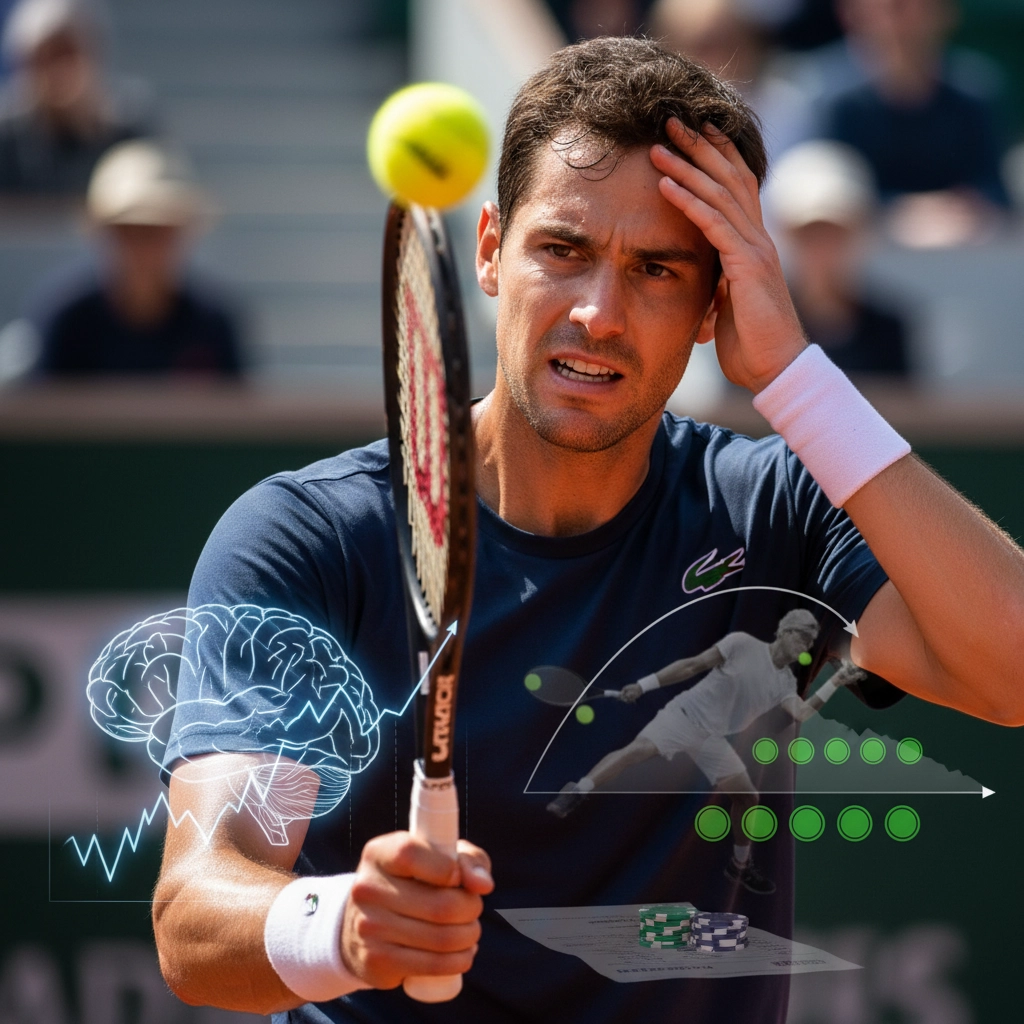
Building a simple mental-vs-form scoring system
Turn the qualitative signals you scan into numbers you can compare. Start with two parallel scores — Mental and Form — each on a 0–100 scale. Keep the calculations transparent and repeatable so you can backtest and refine.
Mental score (0–100) — combine 3–5 indicators:
– Deciding-set and tiebreak win rate (weighted by sample size). Convert to a percentile against tour peers.
– Break-point conversion/save differential in pressure moments (final two service games, tie-break points). Scale relative to opponent averages.
– Recent comeback and recovery metric (wins after dropping first set; wins following a losing streak).
– Behavioral/consistency adjustment (+/- up to 5–10 points) based on reliable qualitative signals: coach stability, visible on-court composure, and press-conference tone.
Form score (0–100) — combine measurable match metrics:
– Recent match results weighted (e.g., last 5 matches × 0.5, matches 6–10 × 0.3, older form × 0.2).
– Serve and return efficiency (first-serve %, return games won) converted to z-scores and normalized.
– Surface-adjusted form modifier (multiply by surface relevance factor: 1.0 for preferred surface, 0.7–0.9 for neutral, Applying the model to bets, stakes and live decisions
Once you have probabilities, compare them to bookmaker odds to find value. Convert odds to implied probability, then compute edge = model_probability − implied_probability. Set simple staking rules:
– Edge 10%: larger unit (consider Kelly fraction or a capped flat-betting multiplier).
Practical live-betting rules where mental factors often pay off:
– If a favorite loses the first set but your mental score is significantly higher and physical indicators look fine, consider backing the favorite in-play; resilient players often recover.
– After long momentum swings, re-evaluate the mental component: a player who visibly crumbles under pressure is unlikely to regain control in the same match.
– Adjust for fatigue: long matches increase the weight of mental resilience and stamina; shift your weights accordingly as the scoreboard grows.
Example (brief): Player A — Form 72, Mental 65. Player B — Form 68, Mental 58.
Default weights (Form 60 / Mental 40): A = (72×0.6)+(65×0.4)=69.8. B = (68×0.6)+(58×0.4)=64.4.
Normalize: A probability ≈ 52.0%, B ≈ 48.0%. If market odds imply A at 60%, there’s no value; if odds imply A at 45%, you have an edge.
Make this model your baseline, not an oracle. Use it to identify edges fast, then layer in match-specific nuance before committing stake.

Putting the system into practice
Turn the model into a discipline: backtest on historical matches, log every bet and outcome, and iterate your weights only when you have meaningful sample sizes. Protect your bankroll with predefined staking rules, and resist the urge to override the model based on short-term emotions. Use trusted data sources for your inputs and refresh them regularly — for comprehensive match stats and head-to-head data consider resources like Tennis Abstract. Small, consistent improvements to your process will compound faster than one-off “sure things.”
Frequently Asked Questions
How should I decide whether to favor mental toughness or form for a specific match?
Start with the default Form 60 / Mental 40 weighting and adjust for context: increase mental weight for likely long matches, close head-to-heads, or players with proven clutch records; increase form weight for early rounds, clear physical mismatches, or surface dominance. Validate adjustments by tracking model accuracy over time.
What are reliable proxies when mental-toughness data is limited?
Use deciding-set and tiebreak win rates, comeback frequency (wins after losing the first set), break-point performance in pressure games, and consistency of behavior (coach changes, on-court composure). Treat small samples cautiously and apply conservative adjustments until patterns persist.
Is this approach suitable for live betting, and how should I adjust in-play?
Yes — it’s particularly useful live. After momentum shifts or a surprise first-set loss, re-weight toward mental if the disadvantaged player has shown resilience and appears physically fine. Conversely, if a player visibly crumbles or has mounting fatigue, increase the form/freshness penalty. Always re-evaluate staking size as the match unfolds and odds move.